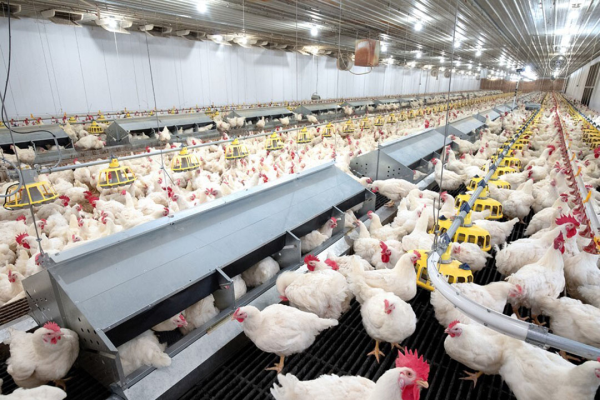
Whole-house nitrogen gas depopulation is emerging as a potential option for poultry producers seeking a depopulation method that prioritizes bird welfare while remaining effective at commercial scale.
The approach involves injecting liquid nitrogen into a poultry house through a dedicated distribution system. As the liquid nitrogen vaporizes, it expands dramatically in volume and initially spreads along the barn floor. As the nitrogen gas gradually warms, it rises, pushing oxygen-rich air upward and out through roof ventilation openings. This process creates low-oxygen conditions that lead to unconsciousness once oxygen levels drop to about 8 percent, before birds experience any significant reduction in body temperature.
Data generated by Livestock Welfare Strategies indicate that birds begin to lose sensibility at roughly 8 percent oxygen, with death occurring before oxygen levels fall to 2 percent. These findings have been supported by preliminary results from implanted monitoring devices used in nearly 1,000 birds, which tracked heart rate, body temperature and movement throughout the process.
From an operational standpoint, the system requires a dwell period of approximately seven minutes before initiation, with the depopulation process itself completed in about five minutes. Observations from trials suggest that nitrogen depopulation produces different behavioral responses compared with carbon dioxide-based methods. Nitrogen exposure results in a calmer environment, whereas carbon dioxide has been associated with more pronounced distress behaviors.
Birds exposed to nitrogen gas typically continue normal activities, including walking and foraging, until oxygen levels decrease to the point where sensibility is lost. After loss of consciousness, about one-quarter of birds display minor reflexive movements.
Trials using whole-house nitrogen depopulation have been conducted since 2020, with the method applied in 55 commercial facilities and achieving a reported success rate of 99.99 percent. The system has been tested across a wide range of production settings, including broiler houses, conventional and enriched cage layer systems, cage-free operations and turkey facilities. Trial sizes have ranged from small turkey operations housing a few hundred birds to large layer houses with up to 80,000 birds, with the largest evaluation involving 130,000 birds.
Future research efforts will focus on optimizing system design, developing emergency response protocols and establishing euthanasia guidelines. Additional scientific publications detailing the method and its outcomes are also in development.