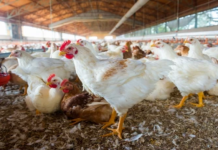
Healthy livestock mean a more substantial and sustainable agribusiness sector to support society’s goals for well-lived lives and livelihoods.
But highly pathogenic avian influenza is threatening that notion.
“Disease doesn’t discriminate. The safety and sustainability of our animal ag supply chains of meat and eggs start with healthy animals,” said Chris Herr, executive vice president of PennAg Industries Association. “Right now, we are seeing in real time the shock and repercussions livestock disease, such as highly pathogenic avian influenza, can have on agribusinesses, global food security, the environment and the American consumer.”
PennAg Industries, a full-service agribusiness trade membership, has been working alongside its members, farmers and agribusinesses to assist in enhancing animal health and welfare.
Services range from management of disease preparedness to humane depopulation practice training to resource sharing — whether biosecurity, a recovery fund or resource connection.
And the association is working to help global ag in addition to the industry at home.
Earlier this year, PennAg members in the Pennsylvania poultry industry met with an Australian agriculture delegation to discuss animal welfare technologies’ practical and economic feasibility.
“The delegation’s visit to Pennsylvania allowed them to hear real-world HPAI experiences from a farmer’s perspective and familiarize themselves with the management response to the outbreaks,” Herr said. “Since they have yet to experience an ongoing outbreak, like we are here in the United States, they want to be prepared for the worst if it infects their poultry industry.”
Australia remains free of highly pathogenic avian influenza, specifically the H5 strain, but recently encountered a low pathogenic strain, H7.
Their free status isn’t stopping them from preparing.
Australia is using a One Health approach as officials make emergency animal disease preparations in case highly pathogenic avian influenza does become a threat to the country’s $3.9 billion poultry industry.
“The infectiousness of this strain of HPAI is unlike anything that we have seen in Australia, and it will require genuine collaboration between all parts of the poultry industry and government to respond effectively,” said Duncan Worsfold, a consultant and recently retired technical specialist with the Victoria Department of Agriculture. “We still need to convince the right people to be able to invest in the right technologies and capability building. The Australian industry and government could be better connected, particularly in relation to strategic investment for building capability, such as trials and exercises for depopulation.”
Since the first case of highly pathogenic avian influenza in 2022, PennAg has been actively working to enhance communication between the poultry industry and the Pennsylvania Department of Agriculture to improve collaboration.
Before 2023, the industry, government and labs withheld virus detection information from each other until it was reported officially as positive by the National Veterinary Services Laboratory, Herr said.
“It would take four days or more to confirm suspected cases,” Herr said, “potentially allowing the virus to spread as most of the industry would be unaware.”
PennAg has improved transparency between farmers and government’s animal health officials by creating a contact list of industry members and sending out poultry health notices and other communications that could impact poultry farms.
“That has been a huge factor in reducing the anxiety that we were all feeling because, at that time, we didn’t know what was going on,” said PennAg member Shelly Koch of Koch’s Turkey Farm in Tamaqua, Pennsylvania. “By 2023, we started to mitigate the anxiety by coming together and deciding to tell each other about suspect positives, stating, ‘I’d rather be prepared and not have an issue than have an issue we didn’t know about four days or more ago.’”
The Australian delegation was impressed with the close-knit ties between competing companies within the Pennsylvania poultry industry.
“These companies are conscious of trying not to infect each other if one happens to become infected with HPAI, which displays a good working relationship between them and seems to help a lot during disease outbreaks,” said Sally Thomson, principal veterinary officer at Australia’s Department of Agriculture, Fisheries and Forestry.
PennAg is often out in the field with its members during animal health emergencies, including avian influenza farm infections.
Herr and Dan Hougentogler, PennAg’s biosecurity consultant, have been on over 40 farms, working with the farmers and industry partners on biosecurity, depopulations and business continuity plans.
For most poultry farms, depopulating a flock becomes a balancing act between practical methods close to euthanasia practices and protection of the community, other flocks and the farmers and responders.
“There is an ‘emotional fog’ that comes with being told you’re about to lose your entire livelihood for six months,” Herr said.
Pennsylvania is the only U.S. state to offer producers a statewide program to help with income lost during this time, ensuring they can continue production in the future.
As avian influenza cases have increased among egg-laying flocks, the public has spoken out against culling infected birds.
Herr emphasized they do not understand how this virus works.
“From my perspective, as someone on the ground, the criticism of depopulating is a bit unfair. There is no alternative for birds who have the virus. There’s no bringing them back,” Herr said.
Avian influenza symptoms also usually appear quickly in several or all birds in an infected flock.
“I’ve stood in a barn for two to three hours, watching these birds go from healthy to barely breathing. It’s challenging and emotional to eliminate a bird perceived as healthy and then within a short time, seeing them become severely sick and suffering,” Herr said. “You feel for the animals, and it comes down to doing the humane thing, which is euthanasia or, in large cases, depopulation.”
For the necessary depopulation, PennAg has advocated for use of a nitrogen-based method that is more humane than older methods, including ventilation shutdown plus heat.

The association and the Department of Agriculture are jointly investing in an AES Inc. high-expansion nitrogen foamer to increase its response capacity and meet as high a welfare standard as possible.
Once the foamer is ready, PennAg hopes to offer training and seminars for poultry and swine industries.
“Our training will ultimately prepare someone for what to expect during a depopulation, which, at the end of the day, gives better clarity on what happens but also eases the uncertainty and discomfort that comes with going through this process,” Herr said.
On the legislative front, PennAg has secured a series of resources for the animal agriculture industry.
The creation of a recovery fund in Pennsylvania has supported smaller, family-owned farms, aiming to help with the mental health aspects.
“We need to keep these smaller farmers in business, as their operations contribute to the local economy and services. Raising poultry is their livelihood, so this fund helps ease the stress after dealing with this virus,” Herr said.
PennAg has also developed a rapid response program, leveraging state and industry resources to show up with integral equipment and trained personnel.
This fast response program is a centralized and expanding stockpile where PennAg, the Department of Agriculture and allied industry members can deploy to assist others in a time of need. This quick attention in a disease situation is critical in stopping virus replication and protecting communities from lateral spread.
In addition to the nitrogen foamer, PennAg is investing in biosecurity resources that can be deployed to an avian influenza-positive farm or agribusiness that needs to increase biosecurity.
Additionally, the PennAg team has worked with U.S. Sens. John Fetterman and Dave McCormick, informing them on the current outbreak and advocating for more USDA support for their farmers.
“We are all about protecting and aiding efforts of Pennsylvania’s livestock animal health, whether it’s seeing a vaccine become available and accepted among our export trade partners to sitting on a tailgate talking to a farmer about what resources they can access to help them through the next six months, or more, PennAg is there,” Herr said. “ At the end of the day, it’s about the animal and the farmer. We do our best as an organization to keep both healthy, successful and sustainable for the future.”