The USDA’s Livestock, Dairy, and Poultry Outlook: August 2025 provides fresh insight into poultry markets, where production shifts, price pressures, and disease impacts are shaping the landscape for broilers, eggs, and turkeys.
Broiler Production Moves Higher
U.S. broiler production for June totaled 3.93 billion pounds, a 5.4% year-over-year increase. Much of the gain came from the additional slaughter day in June compared to 2024, though slightly heavier slaughter weights also played a role.
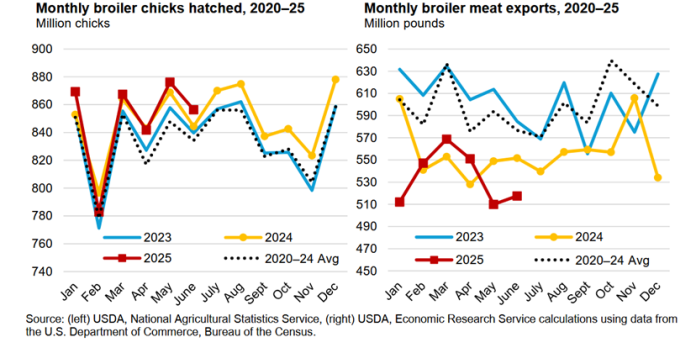
For the second quarter overall, broiler output reached 11.87 billion pounds, up nearly 2% from last year. Strong hatchery data continues to support expansion, with 856 million chicks hatched in June, up 1.4% from the previous year. Reflecting these gains, USDA raised its 2025 broiler production forecast to 47.76 billion pounds, 1.6% higher than 2024.
For 2026, output is forecast at 48.15 billion pounds, a further 0.8% increase, aided by favorable grain prices and limited availability of competing meats.
Per capita broiler disappearance is projected at 102.7 pounds in 2025 and 102.8 pounds in 2026, continuing a long-term trend of steady growth in chicken consumption. For comparison, retail disappearance stood at just 80 pounds in 2012.
Broiler Prices Ease Back
Despite robust production, broiler prices have softened. The national composite whole broiler price averaged 131.4 cents per pound in July, down 5.4 cents from June. Weekly averages slipped further into early August, reaching 120.3 cents per pound.
As a result, quarterly projections for the third and fourth quarters of 2025 were lowered to 128 cents and 130 cents per pound, respectively. The annual average is now expected to be 131.2 cents per pound. For 2026, USDA trimmed its forecast to 134.5 cents per pound.
Exports also remain pressured. June shipments totaled 517 million pounds, down 6.2% year-over-year, with Mexico as the largest buyer. First-half exports are down 3.6% compared to 2024, and the 2025 annual forecast was revised to 6.48 billion pounds (13.6% of production).
Table Eggs: Flock Remains Below Normal
The U.S. table-egg flock is still under pressure following recent reductions. June production totaled 589 million dozen, down 6.1% year-over-year, driven by a smaller layer flock (287 million hens, down 5.6%) and slightly weaker lay rates.
USDA cut its 2025 egg production forecast to 7.32 billion dozen, down 5.4% from 2024. Projections assume the flock will stabilize but remain at historically low levels through year’s end.
Egg prices remain volatile. New York wholesale large eggs averaged $3.41/dozen in July, spiking mid-month to $3.70 before falling sharply in early August to $2.67/dozen. The 2025 annual average price projection stands at $4.12/dozen, while 2026 is expected to drop significantly to $2.16/dozen as flocks rebuild and supplies normalize.
Turkeys: Supply Down, Prices Climb
Turkey production for 2025 has been revised slightly downward to 4.79 billion pounds, a 6.4% decline from last year. While June slaughter was stronger than expected (16.4 million head), lighter weights in July and August are offsetting those gains.
The industry continues to recover from avian metapneumovirus, which has constrained growth, though no new cases of highly pathogenic avian influenza (HPAI) have been reported in recent months. For 2026, turkey production is forecast to rebound to 5.12 billion pounds, a 6.9% increase.
Prices are responding to tight supplies and strong demand. The 2025 wholesale price forecast for frozen whole hens has been raised to 127.3 cents per pound, with third-quarter prices projected at 150 cents and fourth-quarter at 145 cents per pound. For 2026, prices are expected to ease slightly to 131 cents per pound, though still well above pre-2023 levels.
Exports are providing further support, with 2025 shipments revised upward to 412 million pounds, while imports are projected at a modest 35 million pounds.
Outlook
The poultry sector in 2025 is defined by expansion in broilers, contraction in eggs, and resilience in turkeys. Producers are seeing softer broiler prices despite strong production growth, while egg producers continue to face tight supply and volatile markets. Turkey prices remain elevated as supply recovery lags.
As the year progresses, disease management, feed cost dynamics, and consumer demand shifts will remain the key factors shaping profitability across poultry markets.
📄 Full USDA report: Livestock, Dairy, and Poultry Outlook: August 2025 (PDF)